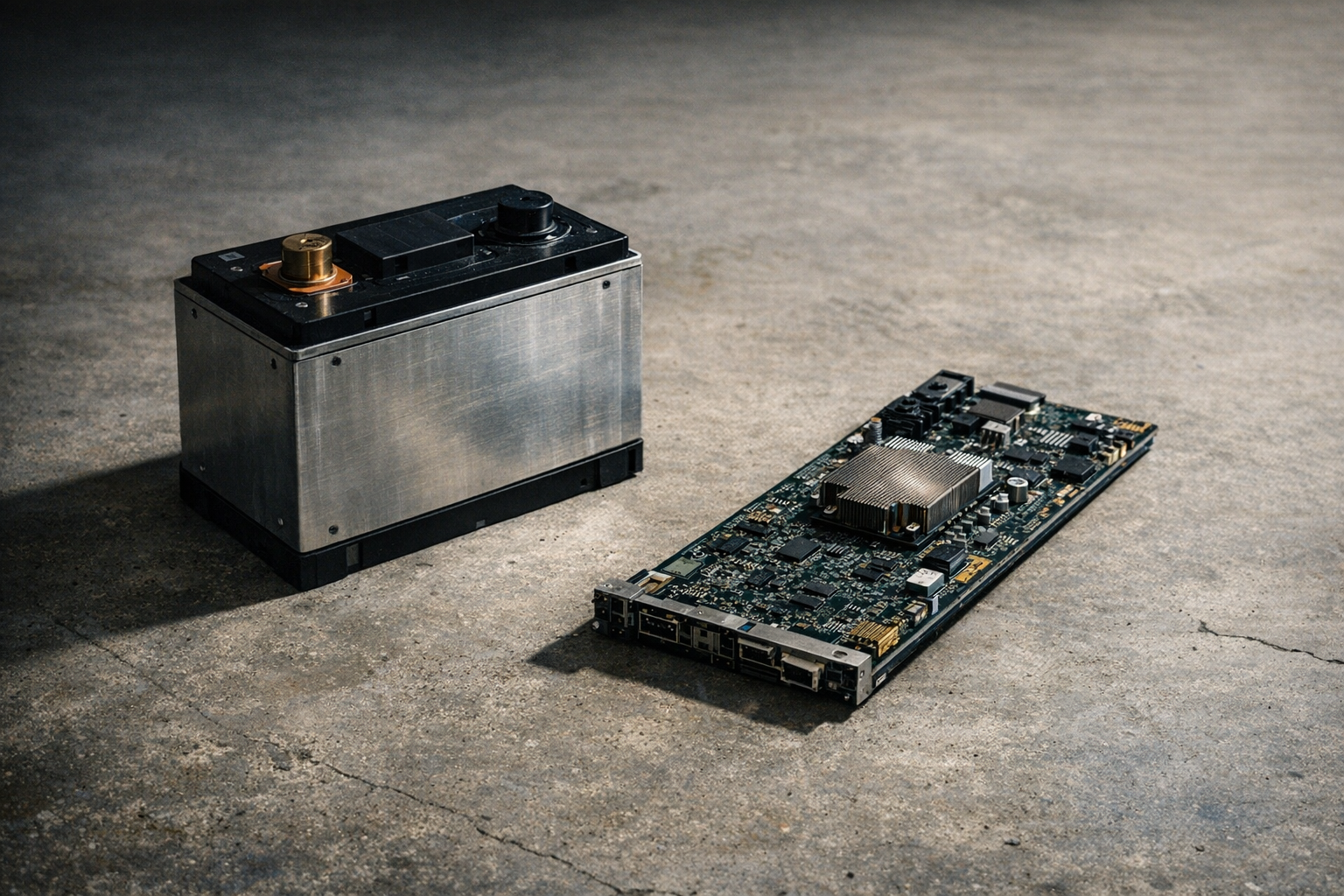

DeepSeek's first external fundraise lands today at roughly $7.4bn, anchored by Tencent, battery maker CATL, and a state-backed national AI fund. The notable fact is not the valuation. It is who is no longer at the table: independent venture money. The Chinese AI race has been recapitalised by industrial and energy balance sheets, and that changes what Western model providers are actually competing against.
The cap table as strategy
Read the investor list as a memo, not a deal. Founder Liang Wenfeng is putting in 20 billion yuan of his own money, the single largest cheque. Tencent is in for around 10 billion yuan, CATL for 5 billion, with NetEase, JD.com, IDG, Monolith and a state-backed AI fund filling the rest. Fewer than ten names total. [1] [2]
Compare that to the Western frontier-model cap tables. OpenAI has Microsoft at roughly 30% plus a sprawling secondary market. Anthropic has Amazon and Google as competing strategic anchors. Scale AI took $14.3bn from Meta. [3] Each Western lab sits inside the orbit of a single hyperscaler whose interest is API monetisation and cloud pull-through. DeepSeek sits inside the orbit of a social and gaming distribution monopoly (Tencent), the world's dominant battery and grid-storage company (CATL), an e-commerce and logistics network (JD.com), and the Chinese state. The customer surfaces are wider, the cost of capital is lower, and nobody at the table needs DeepSeek to hit a 70% gross margin on inference tokens next year.
That is the fact Western boards have not yet absorbed. They are benchmarking model quality. They should be benchmarking patience.
Why CATL's stake is the tell
The CATL position is the part of this round that should make American finance chiefs sit up. CATL has no model, no compute cluster, no AI research history. Its presence is explained by one line in the Reuters report: it has been exploring opportunities to provide power equipment and energy storage solutions as AI workloads drive demand for large-scale, reliable power. [4]
CATL is buying a position in the demand curve for its own next-decade product line. The Western equivalent would be if a major US utility took a $735m strategic stake in Anthropic to secure a relationship with the largest single load on its grid by 2030. That has not happened. The closest analogue is the hyperscaler power-purchase market, but those are procurement contracts, not equity. CATL is using AI equity to underwrite its own energy infrastructure thesis, and DeepSeek gets preferential access to the power, storage and grid kit it will need at industrial scale. The same logic applies in reverse to Tencent's distribution, JD's logistics data, and the state fund's chip-supply backstop via the Big Fund. Every investor is buying an option on a supply chain it already controls.
This is not what a Sequoia round looks like. It is what Mitsubishi or Samsung looked like in the 1970s. The capital is cheaper because it is partly paid back in adjacencies the investor was going to build anyway.
The compute-wall arbitrage
CLSA's Bhavtosh Vajpayee has been arguing that Western AI is heading into a compute wall in which token demand outruns supply and enterprises start rationing workloads to cheaper models. [5] Google, Microsoft, Amazon and Meta are projected to spend close to $600bn on AI infrastructure in 2026. [6] Even at that level, the unit economics force a hard choice between margin and market share.
DeepSeek does not face that choice on the same terms. Its capital base does not need to clear a venture return hurdle, and its energy supply is being co-invested by its own shareholder. If the CLSA thesis is even directionally right, the enterprise procurement question in 2027 becomes: do we pay OpenAI's published price per million tokens for frontier quality, or do we route 60% of internal workloads to a DeepSeek-class open-weights model running on a Chinese or third-country cloud at a fraction of the cost? European banks, Gulf sovereigns and Southeast Asian telcos are already asking that question. DeepSeek reportedly gave early access to its upcoming model to Chinese companies only, withholding it from American engineers. [7] The decoupling runs both ways now, and it favours whoever can serve the non-aligned middle of the market cheapest.
Alibaba has already pointed at the playbook with its open-weight Wan 2.7 video model: release capable models freely, capture global developer mindshare, strand Western API revenue. [8] DeepSeek's open-source posture, now funded for years rather than quarters, extends that strategy to the language-model layer.
The counter-case: industrial capital is distracted, not patient
The strongest argument against this thesis is governance. Industrial conglomerate consortia have a poor track record of backing frontier research. CATL's board owes its fiduciary duty to the battery franchise. Tencent's own model Hunyuan trails ByteDance's Doubao and DeepSeek itself; a stake in a competitor is partly a defensive hedge against Alibaba's Qwen, which is the kind of mixed motive that produces board-level friction rather than R&D acceleration. [9] Add the state AI fund, which carries a policy mandate, and you have a cap table where three of the largest shareholders want different things. The historical pattern is that such consortia are slow on capex decisions and slower on talent compensation, both of which kill frontier labs.
This argument is real, and it is the part of the story most likely to embarrass the bulls in the next cycle. But it underestimates two things. First, Liang Wenfeng's 20 billion yuan personal stake is larger than any outside cheque, which preserves founder control in a way that Sam Altman's structure at OpenAI no longer does. Second, the misalignment cuts the other way: because each strategic investor cares mainly about its own adjacency (power, distribution, logistics, state strategic autonomy), none of them needs to micromanage the model roadmap. The governance risk in Western labs, where Microsoft and OpenAI are publicly negotiating over IP rights and Anthropic's two cloud anchors are fighting for compute priority, is arguably worse than what DeepSeek faces. Distracted shareholders can be better than rival ones.
The counter-case survives only if the state fund forces conditions that compromise the research. That is a real risk worth tracking, but it is not yet evidence.
What to watch
1. CATL's data-centre capex disclosures in its next two quarterly results. If CATL announces specific AI-power and grid-storage joint ventures with DeepSeek or its compute providers within nine months, the vertical-integration thesis is confirmed and Western utility-to-AI partnerships will need to move from procurement contracts to equity. If CATL stays silent through mid-2027, the stake was financial rather than strategic, and the thesis weakens.
2. Enterprise procurement disclosures from at least three non-US Fortune 500 buyers. Watch for European banks, Gulf national oil companies or Japanese trading houses naming DeepSeek or a DeepSeek-derived model as a primary or secondary model vendor by Q3 2027. One such disclosure is anecdote; three is a procurement shift. Zero by year-end means the compute-wall arbitrage has not materialised on the enterprise side.
3. US Treasury or Commerce action on outbound investment and cloud access tied to the DeepSeek cap table. The House Select Committee on China held its April 2026 hearing on China's Campaign to Steal America's AI Edge. [10] An entity-list addition for DeepSeek, or a restriction on US persons providing services to its investors, would force Tencent and CATL to choose between their AI stake and their Western customer base. The absence of such action by mid-2027 tells you the political consensus on decoupling is softer than the rhetoric suggests.
Sources
[3] https://pitchbook.com/news/reports/q2-2026-building-backing-and-buying-ai
[5] https://www.cnbc.com/video/2026/06/09/the-ai-boom-is-about-to-run-into-a-compute-wall-clsa.html
[6] https://pitchbook.com/news/reports/q2-2026-building-backing-and-buying-ai